Are Catamarans Better In Rough Seas?
Why catamarans behave more steadily in choppy water, what sea conditions mean for a Mallorca day sail, and what happens when weather cancels a trip.
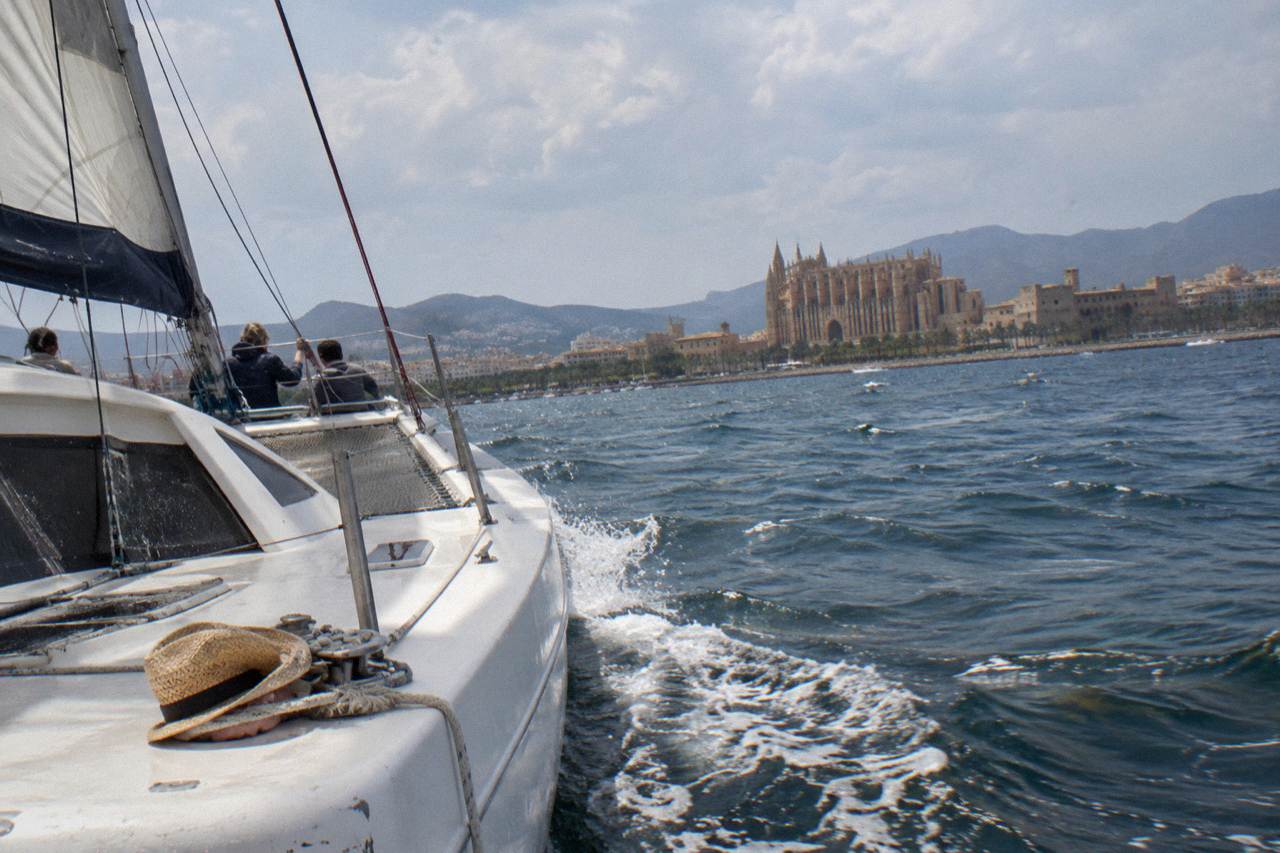
Yes, in the specific sense that matters to passengers: two hulls spread wide apart resist the rolling motion that makes people seasick, so a catamaran in the same chop as a single-hull boat tends to sway less from side to side and offers a flatter deck for eating, walking and swimming. That is a comfort advantage in short chop, not a guarantee of calm water or a safety verdict, and no boat type makes rough weather pleasant.
The honest version of this answer starts with what a catamaran actually is. Two parallel hulls connected by a wide deck give the boat a broad stance, a bit like standing with your feet apart rather than together. When a wave lifts one hull, the other hull resists, and the boat tilts less than a single-hull vessel of similar size would in the same water. Passengers feel this mostly as reduced roll, the side-to-side rocking that turns stomachs on smaller craft.
What a catamaran does not do is remove the sea from the equation. Short, steep chop inside a bay can still bounce a catamaran, and the twin-hull design trades some of the deep, cork-like motion of a heavy single hull for a quicker, flatter response. Some sailors prefer the feel of one, some the other. For a day guest who wants to keep a plate level and stand at the rail without gripping it, the catamaran layout is generally the friendlier of the two.
Every catamaran trip covered on this site is a guided excursion, which matters here more than hull geometry. A professional crew decides whether conditions suit the route, the swim stop and the harbour exit, and the departure goes or does not go on that judgement rather than on the passenger's tolerance for swell. The design makes the comfortable days more comfortable; it does not create the comfortable day.
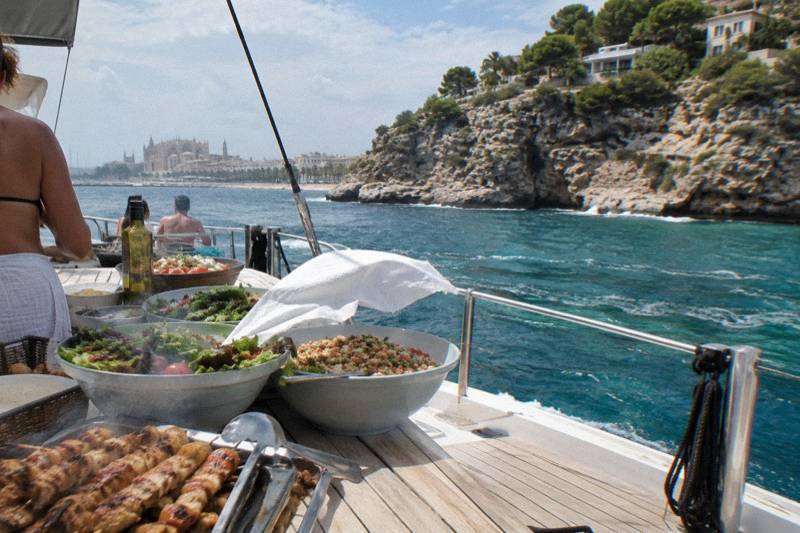
The first is a Bay of Palma barbecue sail on a catamaran that carries up to 36 guests, from $92 per person for a 4 hour trip. The second is the most reviewed listing on this site, 4.5 from 3,654 reviews, a 5 hour morning or 4 hour sunset trip from $61.62 per person with a gourmet buffet and a DJ. The third is the east coast option, a 4 hour trip from Cala Ratjada from $113 per person with a traditional Mallorcan lunch, rating 4.6 from 16 reviews.
Why Two Hulls Change How A Boat Moves
A catamaran resists rolling because its two hulls act like outriggers: buoyancy far out to each side pushes back against the tilt, so the deck stays closer to level while a single-hull boat leans into the same wave. The trade is a quicker, sometimes snappier up-and-down motion in short chop, which is why catamarans feel steady rather than soft.
Picture a person carrying a tray of drinks on a moving walkway versus a cobblestone street. The walkway moves but stays flat; the cobbles tip the tray side to side. A catamaran in moderate chop behaves more like the walkway. The wide beam, the distance between the two hulls, is the working part of the design: the further apart the hulls sit, the more the boat has to be pushed before it rolls appreciably. That is also why catamaran decks suit buffets, DJ desks, paddleboard racks and the other furniture of a day sail; the platform under them moves less.
The second effect is emotional as much as physical. Motion sickness tracks strongly with rolling, the slow side-to-side swing that conflicts with what the inner ear and the eyes each report. By damping roll, a catamaran removes much of the trigger. It does not remove pitch, the bow-up-bow-down motion into head seas, and it does not remove the vertical bounce of short wind chop, so a sensitive passenger can still have a hard hour. The crew's route choice, staying inside a sheltered bay rather than rounding an exposed headland, usually does more for comfort than the hull count does.
None of the listings covered here publishes sea-state limits, and none should be expected to. What each listing does show is its route character: several Palma Bay trips stop at Cala Vella inside the bay, the north coast trips work the bays of Alcudia and Pollensa, and the east coast trip from Cala Ratjada sails toward Cap des Freus and the Llevant natural park. Bays are sheltered by geography; the open water between headlands is where a steady hull earns its keep. For more on how conditions interact with the body, the seasickness and sea conditions guide covers prevention and what to expect.
What Rough Seas Mean For A Mallorca Day Trip
In practice, "rough seas" on a Mallorca excursion usually means the crew shortens or drops the swim stop, hugs the sheltered side of the bay, or the operator cancels outright; the listing shows the cancellation policy, and weather can cancel trips. No figure for wave height or wind is published by any listing covered here, so the decision is the crew's, made on the day.
A day sail is not a crossing. Almost every itinerary here is built around a bay: out of the harbour, along the coast, an hour or more at anchor for swimming and paddleboards, then back. When conditions pick up, the anchorage is the first thing to go, because a boat rolling at anchor is uncomfortable and a ladder climb in chop is the part of the day guests remember for the wrong reasons. The sail itself often continues in a modified form.
There are also fixed legal boundaries that shape how close any boat comes to shore. Boats keep to under 3 knots within 200 m of beaches and 50 m of the coast under general swimmer-safety guidance, which is why the swim transfer happens the way it does, with the boat standing off and guests entering the water at a controlled point. Swimmers themselves should read the local flags: green for swim, yellow for caution, red for no swimming, and a white flag with a jellyfish icon signalling jellyfish presence. If stung, rinse with seawater only.
The environmental rules bite too. Anchoring on Posidonia meadows is banned in the Balearic Islands under Decret 25/2018, with authorised buoys as the legal alternative, and Spanish law keeps boats at least 60 m from cetaceans under Real Decreto 1727/2007. A crew that cannot anchor where it planned will move the swim stop, and that is a routing decision, not a sign the day has gone wrong.
The Oasis Catamaran barbecue sail is a useful example of how this plays out. It departs from the Escalera Real on Palma's Paseo Maritimo, works the Bay of Palma, carries up to 36 guests, and lists free cancellation. The bay itself is the shelter: on a day when the open coast is unpleasant, a bay route can still run, shortened at the crew's discretion. Details and availability are on the operator's live listing, and you can also check availability for your dates.
When Weather Cancels A Trip
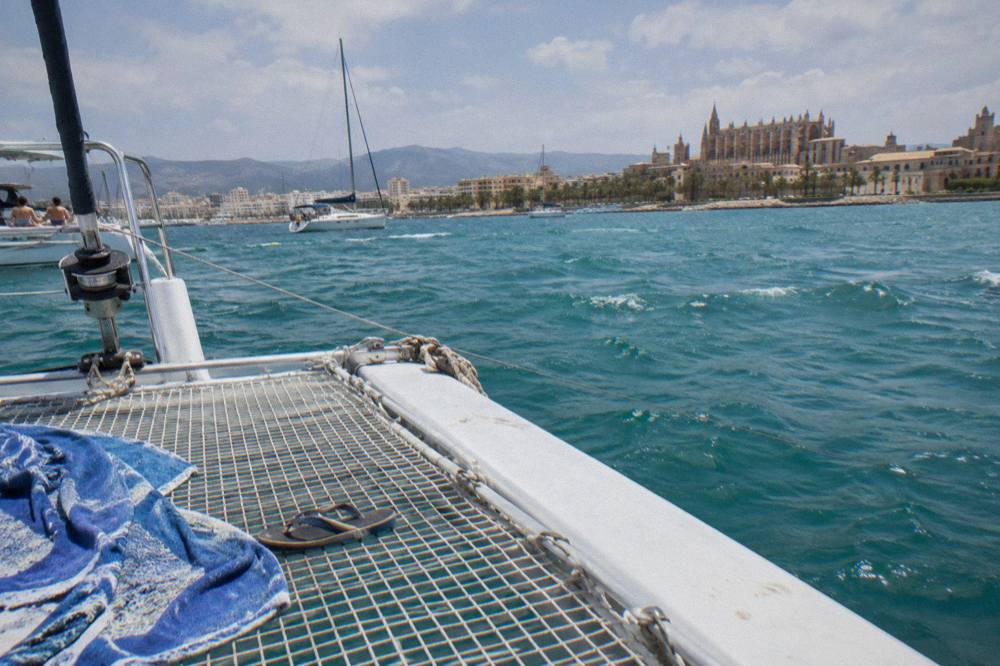
Weather can cancel trips, and the listing shows the policy; several listings covered here explicitly list free cancellation, while the north coast Pollensa Bay trip leaves it unstated, so the specific listing is the place to check before booking. A crew cancellation for weather is a routing and safety call, not a refund dispute waiting to happen.
The pattern across the listings is worth stating precisely, because generalising it would be dishonest. Among the trips discussed here: the Oasis Catamaran barbecue sail lists free cancellation, the Attraction Catamarans luxury tour with meal and DJ lists free cancellation, and the Cap des Freus and Llevant natural park trip from Cala Ratjada states a 24-hour full refund on its listing. Elsewhere on the site, the Pollensa Bay trip does not state free cancellation. Those are facts about named listings, one at a time, and they are the facts that matter when a forecast looks uncertain.
What happens on the day follows a familiar sequence across guided excursions generally: the operator watches the forecast, the captain makes the call, and if the trip does not sail, the booking is handled under the listing's policy. That is the whole reliable sentence. Anything more specific, about rebooking windows or refund timing, belongs to the operator and the live listing, not to a summary written in advance of your particular day.
The most reviewed listing on this site, the Attraction Catamarans luxury tour from $61.62 per person, rates 4.5 across 3,654 reviews, and the review count and rating on the listing are its own. Recent reviews on the live booking page show the current tone, so skim the newest entries before choosing a departure. The count and the rating are the listing's own; read a handful of recent reviews on the live listing for the current tone.
Between the forecast and the departure there is usually a day of waiting, and the waiting is the hard part. A practical approach: book the day you want, know the listing's cancellation terms, and keep one flex day in the itinerary if the trip is the centrepiece of the week. The best time for a catamaran tour guide goes deeper on seasonal patterns.
Sea Temperature And The Months That Feel Different
Average sea temperature near Palma runs from 13.9 degrees Celsius in February, the coolest month, to 26.0 degrees Celsius in August, the warmest, with May at 18.9 and October at 22.7 on the way between them; these are monthly averages, not daily readings, and they shape how long a swim stop feels good rather than how the boat behaves.
The numbers give an honest skeleton for planning. Spring water is brisk: March averages 14.1 degrees, and even May's 18.9 is a short-swim temperature for many people. By late June the average passes 22.5, July sits at 24.8, and August peaks at 26.0. The warmth holds surprisingly well into autumn, September at 25.1 and October at 22.7, before November's 19.7 and December's 16.3 close the year. None of this says anything about waves or wind, only about the water you jump into.
| Month | Average Sea Temperature Near Palma | Month | Average Sea Temperature Near Palma |
|---|---|---|---|
| January | 14.4 °C | July | 24.8 °C |
| February | 13.9 °C | August | 26.0 °C |
| March | 14.1 °C | September | 25.1 °C |
| April | 15.9 °C | October | 22.7 °C |
| May | 18.9 °C | November | 19.7 °C |
| June | 22.5 °C | December | 16.3 °C |
Daylight pairs with the water. Sunset in Palma on the 15th of the month runs from 5:49 pm in January to the summer extreme of 9:18 pm in June, back through 7:58 pm in September to the winter extreme of 5:26 pm in December. A sunset-option trip in June sails in broad evening light; the same option in November happens closer to mid-afternoon departure times. The listings with sunset options state their own departure windows, and those, not the calendar, govern what you actually book.
How Different Coasts Expose A Boat To Conditions
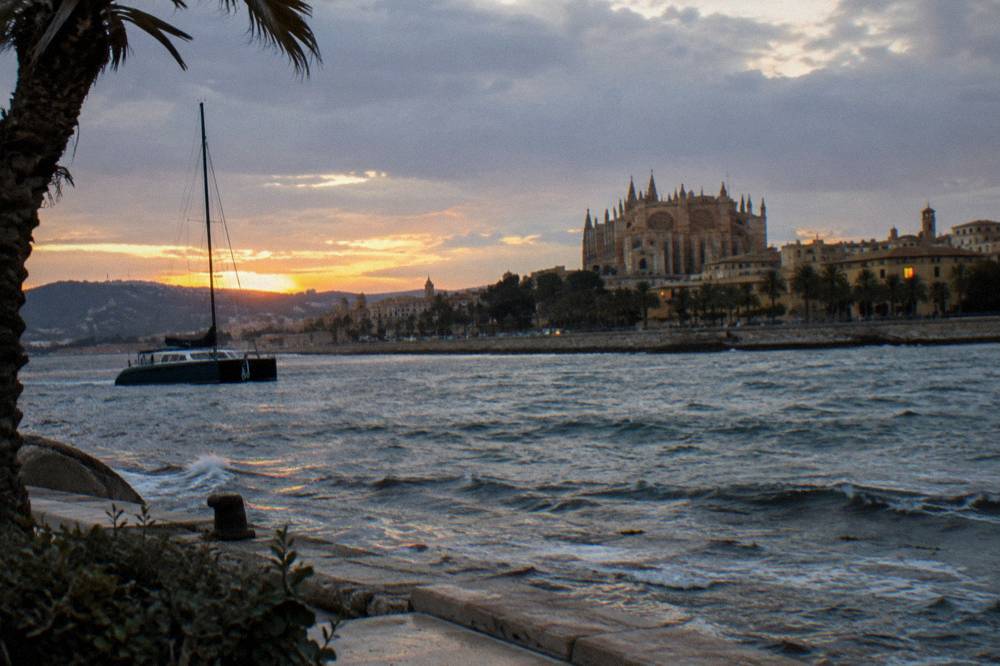
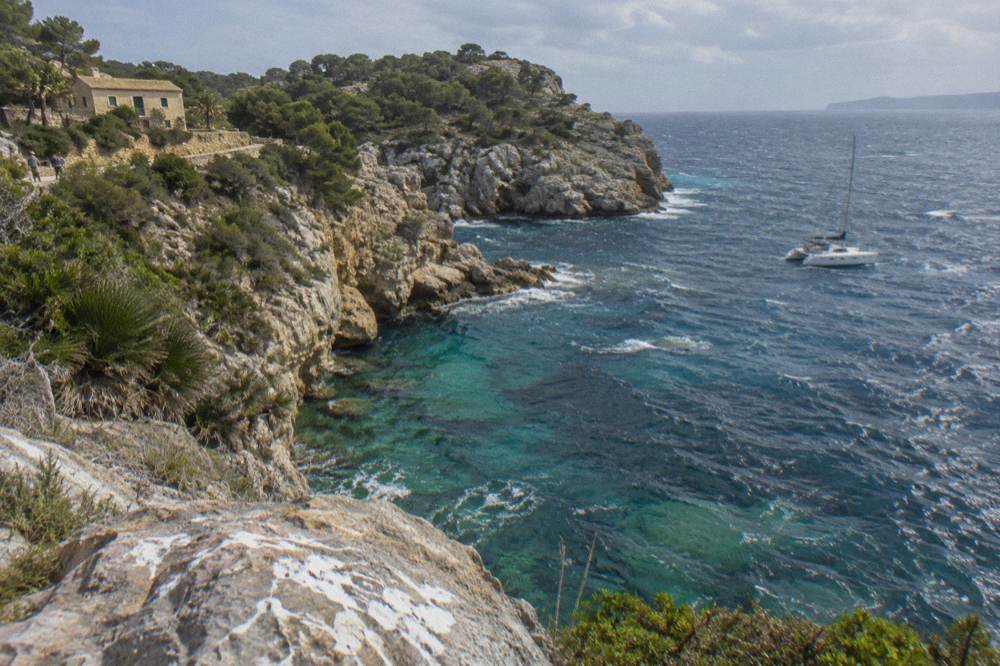
Mallorca's three main catamaran arenas behave differently: the Bay of Palma is a large, partly enclosed bay serving most of the site's listings, the north coast bays of Alcudia and Pollensa sit between exposed headlands including Cap de Formentor, and the east coast trip from Cala Ratjada sails toward Cap des Freus and the Llevant natural park, where open water arrives quickly.
Bay sailing is the sheltered case. A trip that departs Palma and stops at Cala Vella spends its day inside the Badia de Palma, the bay where the Palma catamaran tours make their swim stops. Itineraries here rarely name more than one or two stops, because the bay itself is the product being sold: calm water, swimming stops and the coastline on either side.
The north coast is a different proposition. The Alcudia cruises stop at Platja des Coll Baix and Cala Murta and pass Aucanada Beach, the Pollensa Bay trip stops at Ses Caletes and Formentor, and the Formentor beach trip stops at Playa de Formentor and only passes Cap de Formentor, one of the most exposed points on the island. The Formentor half-day trip from Port d'Alcudia, from $45.55 per person for 4 hours 30 minutes with beach time, carries up to 300 guests, and whatever the vessel, the headland is still the headland. Crews adjust.
The east coast option, the Cap des Freus and Llevant natural park day trip, is the site's one listing from Cala Ratjada, from $113 per person for 4 hours with a traditional Mallorcan lunch, rating 4.6 from 16 reviews. The Llevant park coastline is quieter and more open than the Palma bay, and no listing here is a wildlife trip, so no sighting of any kind can be promised on the day. What the route offers is a genuinely different sea: the same island, a different exposure.
What To Do With All Of This
Book the hull type that suits your stomach, but plan around the policy: read the cancellation terms on the specific listing, keep a flex day, and treat the crew's on-the-day judgement as the safety mechanism it is. A catamaran makes a good day better; it does not rescue a bad forecast, and it was never supposed to.
The practical checklist is short. Check the listing's cancellation line before booking, not after the forecast turns. Pack for the water temperature, not the air temperature, using the averages above as the honest guide. Bring what the catamaran packing guide recommends, because towels are sold onboard on some listings for EUR 8 and snorkel gear on at least one for EUR 20, as those listings state in their exclusions. Read a few recent reviews on the live listing for the current guest experience.
And keep the design question in proportion. Are catamarans better in rough seas? They roll less, they hold a level deck, and they carry the buffet, the DJ and the paddleboards that make a Mallorca day sail what it is. That is the honest ceiling of the claim, and it is enough. The rest of the day belongs to the bay, the crew and the forecast.
This site, Mallorca Katamaran Tours, exists to make that comparison concrete: real listings, real prices with their per-person or per-group basis stated, and no promise the sea has not signed off on.
If the hull question is settled and the booking one has opened, these two trips cover the range discussed here, a Palma bay barbecue sail with Oasis Catamaran and a Blue Circle electric catamaran run from Palma with tapas, SUP and snorkel gear:
Common Questions About Catamarans In Rough Seas
Are Catamarans Better In Rough Seas?
In the sense that matters to day guests, yes: the twin hulls resist rolling, so the deck stays closer to level and motion-sickness triggers are reduced compared with a single-hull boat in the same chop. It is a comfort advantage, not a guarantee of calm water, and no hull type makes a rough day pleasant.
Do Catamarans Cancel Less Often Than Other Boats?
No listing covered here publishes cancellation statistics by boat type, so no such claim can be made. Weather can cancel trips, the listing shows the policy, and the crew's judgement on the day governs whether a departure runs, is shortened, or does not go.
What Happens If My Catamaran Trip Is Cancelled For Weather?
The booking is handled under the specific listing's policy. Several listings covered here list free cancellation, including the Palma bay barbecue sail and the luxury tour with meal and DJ, while only the north coast Pollensa Bay trip leaves it unstated. Check the listing before booking.
When Is The Sea Warmest For Swimming In Mallorca?
Average sea temperature near Palma peaks at 26.0 degrees Celsius in August, with July at 24.8 and September at 25.1. February is the coolest month at 13.9 degrees. These are monthly averages, not daily readings.
Can I See Dolphins On A Mallorca Catamaran Tour?
Passengers on boat trips off the south-west of Mallorca, around the Santa Ponsa and Paguera routes, report bottlenose dolphins, but no listing covered here departs from those ports, and no sighting can be promised on any trip.