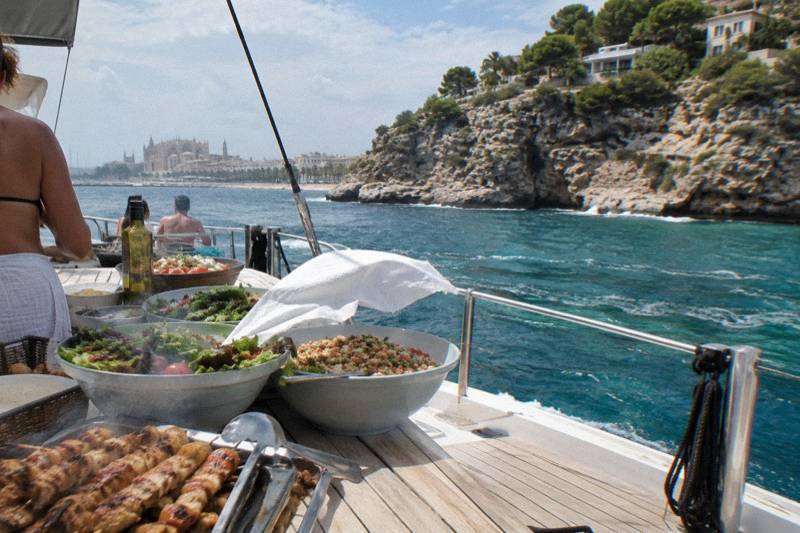
Dolphin Watching Boat Tours In Mallorca: What To Expect
Dolphins live in Mallorcan waters, but no catamaran tour listed on this site is a dolphin-watching trip. Here is what the sightings actually look like, what the law requires of boats, and how to pick a day on the water that satisfies you even if no dolphin appears.
Short answer
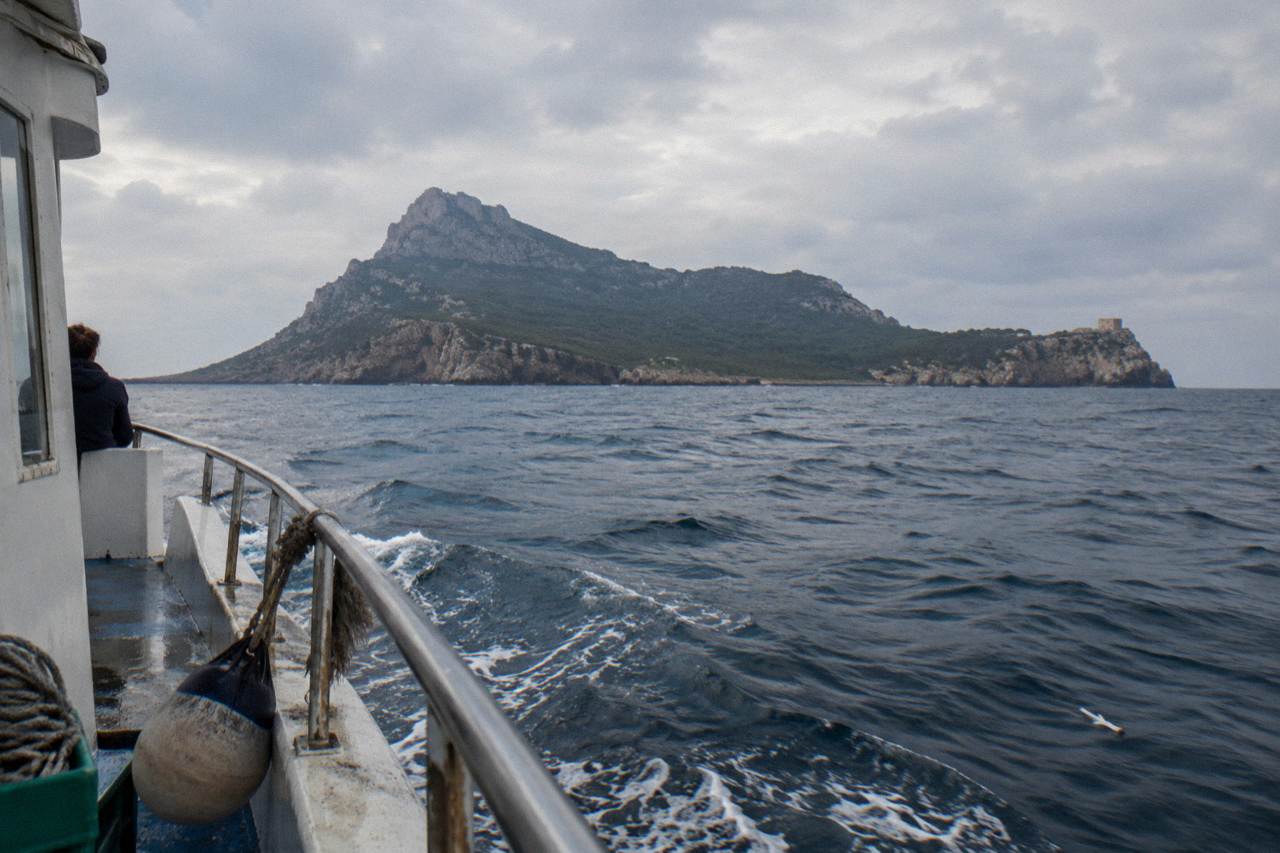
Passengers report bottlenose dolphins on boat trips off the south-west of Mallorca, on the Santa Ponsa and Paguera routes, and no catamaran listing covered here departs from those ports. Spanish law keeps boats at least 60 m from cetaceans under Real Decreto 1727/2007. A catamaran day from Palma, Alcudia, Pollenca or Cala Ratjada runs from $44.82 per person.
What Are The Real Odds Of Seeing Dolphins In Mallorca?
Honest odds start with geography: passengers report pods of bottlenose dolphins on boat trips off the south-west of Mallorca, on the Santa Ponsa and Paguera routes, and no catamaran listing covered here departs from those ports. The listings covered here depart from Palma, Port d'Alcudia, Port de Pollenca and Cala Ratjada. Not one of them is marketed as a dolphin-watching trip, and none of them should be bought as one.
Bottlenose dolphins do appear in Balearic waters, and passengers on dolphin-watching boats off Santa Ponsa and Paguera, two resorts on the island's south-west coast, have reported seeing them. That stretch of water sits roughly opposite Palma's commercial piers, and none of the catamaran tours listed on this site depart there. Their itineraries, where stops are stated at all, run to places like Cala Vella, Cap Enderrocat, Es Coll Baix and Cala Agulla instead.
This matters because the phrase "dolphin boat tour Mallorca" pulls up two very different products. One is a dedicated dolphin-watching excursion, usually a faster vessel out of a south-west resort, sold on the chance of a sighting. The other is a catamaran day with lunch, swim stops and snorkelling, sold on the day itself. Buying the second while hoping for the first is a common disappointment, and it is avoidable by being clear about what each listing actually offers.
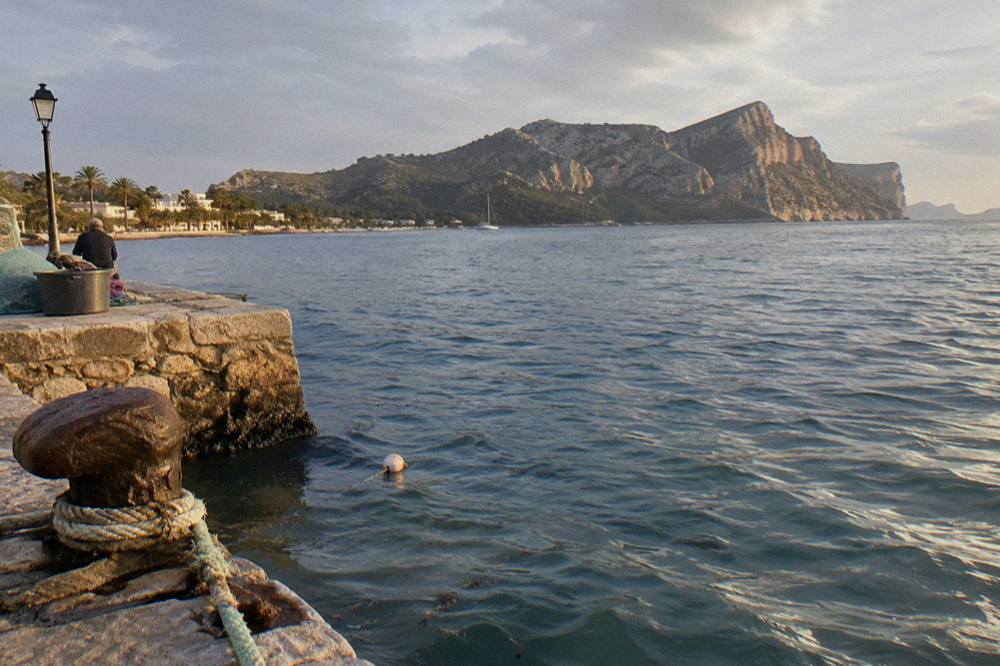
The right frame for a catamaran day is this: dolphins are a bonus, not the product. A five-hour sail with a swim stop at Cala Vella, a BBQ lunch and snorkel gear is a full experience on its own terms. If a pod crosses the bay while you are aboard, that is a genuine piece of luck that guests do occasionally report around Mallorca. Planning the day around the swim stop and the meal, rather than around a sighting, is the version of this trip that does not leave you short-changed. For what actually happens in the water at the stops, the snorkel stops on Mallorca catamaran tours are covered in their own guide.
Which Boat Trips Report Dolphin Sightings Around Mallorca?
The dolphin reports gathered here come from passenger reviews of dedicated dolphin-watching boats running off the south-west coast, on the Santa Ponsa and Paguera routes. Those vessels are not in the listings covered on this site, and no catamaran here claims a dolphin stop. Anyone whose holiday priority is a sighting should book a dedicated dolphin excursion in the south-west and treat the catamaran as a separate, different day out.
What the reports say is plain: pods of bottlenose dolphins, seen from boats, off Santa Ponsa and Paguera, described by passengers during 2026. That is the whole of what is verified. There is no count of how often sightings occur, no season claimed as better, and no operator named as more reliable than another. Any tour that promises you a dolphin in Mallorcan waters is promising something nobody can deliver, and Spanish law in any case forbids boats from closing in on cetaceans, which shapes what even a dedicated trip can do.
A catamaran day does not compete with that. It competes on a different axis: space, stability, food, and time in the water. The listings below are the three this site highlights for a day on the water around Palma Bay, chosen because they span the range of what a catamaran day can be: a shared swim and snorkel cruise from $44.82 per person, a deluxe trip with snacks, drinks, SUP and snorkelling from $85.15 per person, and a premium tour with catering and a VIP option from $95.24 per person. None is a dolphin trip; each is a strong version of the thing it actually is.
The featured pick for readers of this guide is the Palma catamaran cruise with swimming and snorkelling, rated 4.3 from 3,255 reviews and priced from $44.82 per person. Bottlenose dolphins are reported off Mallorca's south-west coast, near Santa Ponsa and Paguera, and no tour in this selection departs from there. This listing sells the parts of a sea day that are guaranteed: a catamaran, stops at Cap Enderrocat and Cala Vella, snorkel equipment, and a BBQ option with water, beer or sangria. Hotel pickup and drop-off are excluded, so visitors staying in the Arenal corridor need to arrange their own transfer to the departure point. Check availability
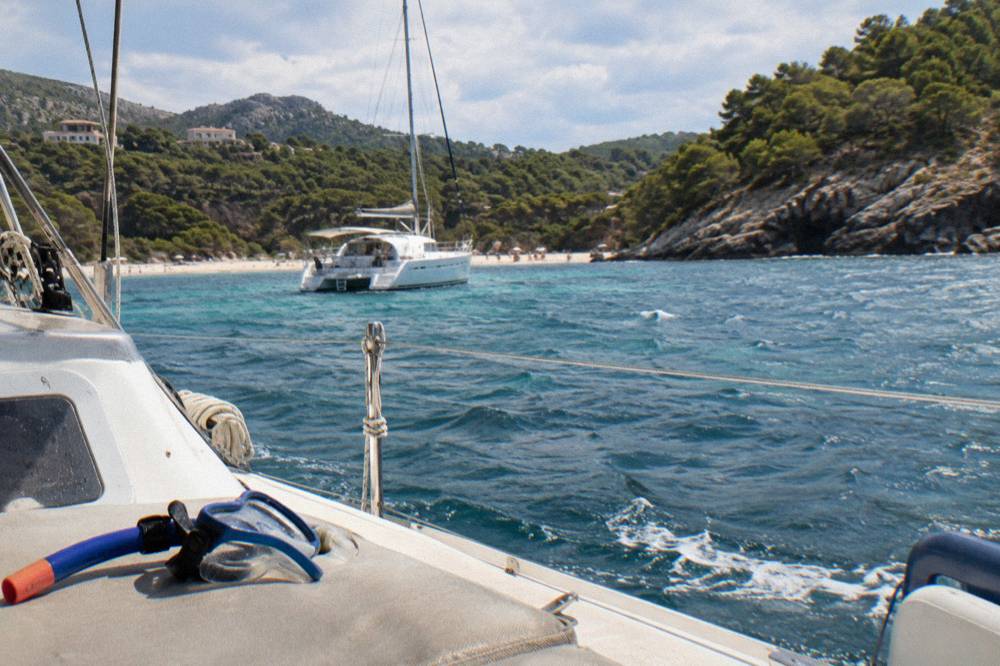
One more honest point about odds. Dolphin behaviour is variable, and even dedicated trips come back without a sighting on plenty of days. The math that works for most visitors is to spend the catamaran budget on the best catamaran day, not on the longest shot at a dorsal fin. If a sighting does happen from the deck, treat it as a bonus rather than the plan of the day. Every sailing on this page stands on its own as a swim, a meal and a coast view, with or without dolphins.
How Does A Catamaran Day Compare To A Dedicated Dolphin Trip?
A dedicated dolphin trip optimizes for one uncertain event; a catamaran day optimizes for a certain one. The catamaran tour puts its meal, its swim stop and its coastline on the itinerary, while the dolphin trip's core payoff stays probabilistic. For most visitors, especially families, the catamaran is the more reliable purchase, with shared listings from $44.82 per person and private charters from $1,389.36 per group.
The comparison comes down to what you can be sure of. On the catamaran side, the listings state their inclusions, and those inclusions happen every time: the gourmet buffet on the Attraction Catamarans luxury tour, the BBQ lunch or dinner with wine, sangria and soft drinks on the Magic Catamarans sail, the BBQ on the Oasis trips, and the tapas with welcome drink on the small-group sails. Swim stops are listed on nearly every shared sail covered here, and the stops are named on most: Cala Vella, Cap Enderrocat, Es Coll Baix, Cala Agulla. You can verify before you pay exactly what the day contains.
On the dolphin side, the payoff depends on animals that do not read itineraries. A good dedicated excursion will also give you coastline, a swim stop and a commentary, so the day is rarely wasted, but the headline promise is the one thing the operator cannot control. And since Spanish law requires boats to keep their distance from cetaceans, the encounter, when it comes, is a watched one rather than a chased one. That is as it should be, and it is worth knowing before you picture a boat shadowing a pod for an hour.
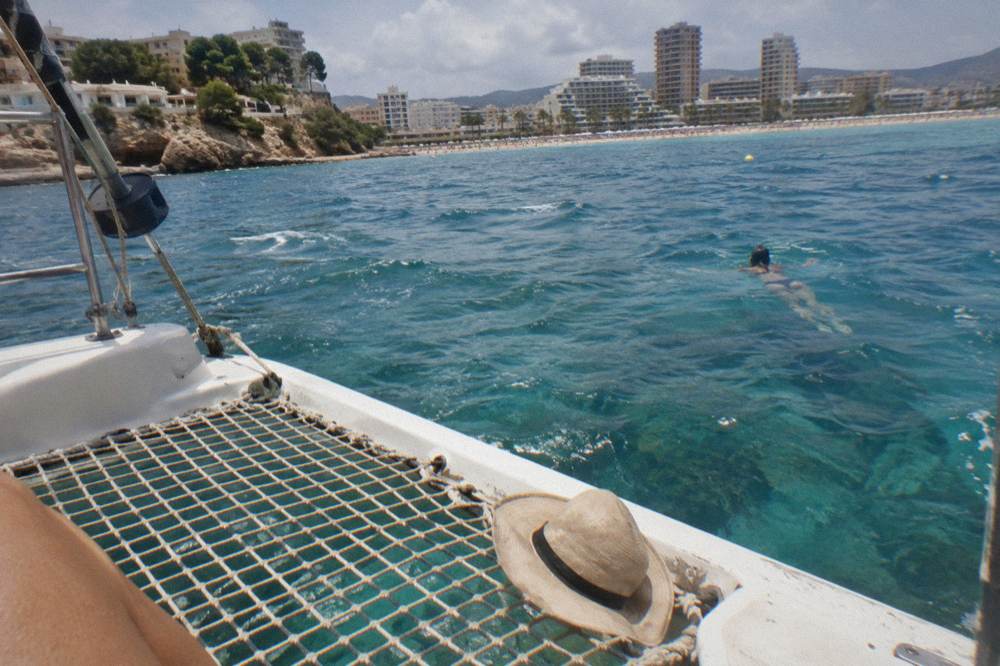
Families should weigh one more factor: attention spans. A catamaran day breaks itself into chapters, sailing, swimming, eating, sailing home, and children stay engaged through each. A dolphin trip has a lot of scanning the horizon between events. The catamaran tours in Mallorca with kids guide covers that trade-off in detail. For adults celebrating something, the private side of the market is stronger than ever: a private catamaran with tapas and coves, from $1,400.56 per group for up to 12 guests, is a different product class from any shared sail.
| Feature | Dedicated Dolphin Trip (South-West) | Shared Catamaran Day (Listings Here) | Private Catamaran Charter |
|---|---|---|---|
| Core payoff | Possible dolphin sighting | Sailing, meal, swim stop | Whole boat, own itinerary |
| Certainty of payoff | Not guaranteed | Stated inclusions as per the listing | Stated inclusions, private use |
| Departure ports used here | None; listings here do not run there | Palma, Port d'Alcudia, Port de Pollenca, Cala Ratjada | Palma |
| Price basis of listings here | Not applicable | From $44.82 per person | From $1,389.36 per group |
| Typical duration | Varies by operator | 2 hours to 5 hours per listing | About 4 hours per listing |
The premium shared option is worth a paragraph of its own. The Mallorca premium catamaran day or sunset trip with food, swimming and a VIP option, operated by Sa Calma Boats, runs 4.5 hours from Palma from $95.24 per person, rated 4.4 from 522 reviews. It sails to Cala Vella in a marine reserve area with a 1.5-hour swim stop, catering on board, water slides, a swim platform and snorkel equipment with a €10 deposit. It sits between the big shared sails and a private charter on both price and feel, and its sunset timing lines up with the island's late summer light, which the Mallorca sunset times by month guide tracks in detail.
Between the two price poles sits a simple question that decides most purchases: does your group want its own boat or a shared deck? The private versus shared catamaran comparison for Mallorca works through it. What the dolphin question adds is almost nothing, because neither format changes the sighting odds; the dolphins are where they are, and the boats go where their itineraries say.
What Is The 60-Metre Rule For Approaching Dolphins In Spain?
Spanish Real Decreto 1727/2007 creates a mobile protection space around every cetacean: a cylinder of 500 m radius, extending 500 m above and 60 m below the animal or group. Inside it, the exclusion zone runs to 60 m, a restricted-permanence zone runs from 60 m to 300 m, and an approach zone runs from 300 m to 500 m. Boats may not enter the exclusion zone, so no legal tour in Spain gets close to dolphins.
The rule is national law, and it applies to every vessel, commercial or private. The zones stack outward from the animal: the closest 60 metres are off limits entirely, the band from 60 to 300 metres limits how long a boat may remain, and the outer band from 300 to 500 metres governs how a boat may approach and must depart. Because the protected space moves with the animals, a skipper's job is constant judgment, not a fixed boundary on a chart. The full text is published by the Spanish official gazette at Real Decreto 1727/2007 on cetacean protection measures.
For a visitor, the practical consequences are few and good. A tour that respects the law will slow down, hold its distance, and let the pod decide whether to approach; dolphins are curious animals and sometimes come to boats on their own, which is the only kind of close encounter Spanish rules contemplate. A tour that circles, chases or cuts in front of cetaceans is breaking the law, and reporting it is reasonable. The rule protects the animals from exactly the pressure that makes sightings rarer over time.

The same body of law is part of a wider set of protections that shape Mallorca's coastal waters. Anchoring on Posidonia seagrass meadows is banned in the Balearic Islands under Balearic Decree 25/2018, and the ban was reinforced nationwide by Real Decreto 191/2026, published in the official gazette in March 2026 (BOE text of Real Decreto 191/2026). The Balearic decree allows only authorised low-impact buoys, mooring fields, or sand patches clear of the meadows. A catamaran cannot simply drop anchor wherever the water looks inviting. It is one reason the swim stops on these trips look the way they do.
Where Do The Catamaran Tours Covered Here Depart From?
The listings covered here depart from four places: Palma (the Muelle de Golondrinas area, La Lonja Marina Charter, D-Marin Palma Cuarentena and the Real Club Nautico), Port d'Alcudia, Port de Pollenca and Cala Ratjada. None departs from Santa Ponsa, Paguera, Magaluf, Port de Soller, Cala d'Or or Cala Millor, which is precisely why none of them is positioned as a dolphin trip.
The geography is the honest answer to the dolphin question. Santa Ponsa and Paguera sit on the south-west coast, facing the water where passengers report bottlenose dolphins. The catamaran fleet covered here works the Bay of Palma, the north coast between Alcudia and Pollensa, and the east coast out of Cala Ratjada. Those are rich, swimmable, scenic stretches of sea, but they are not the reported dolphin lanes. A visitor based in Palma who wants both experiences can do both: a catamaran day from the Palma waterfront and a separate dolphin excursion from a south-west resort.
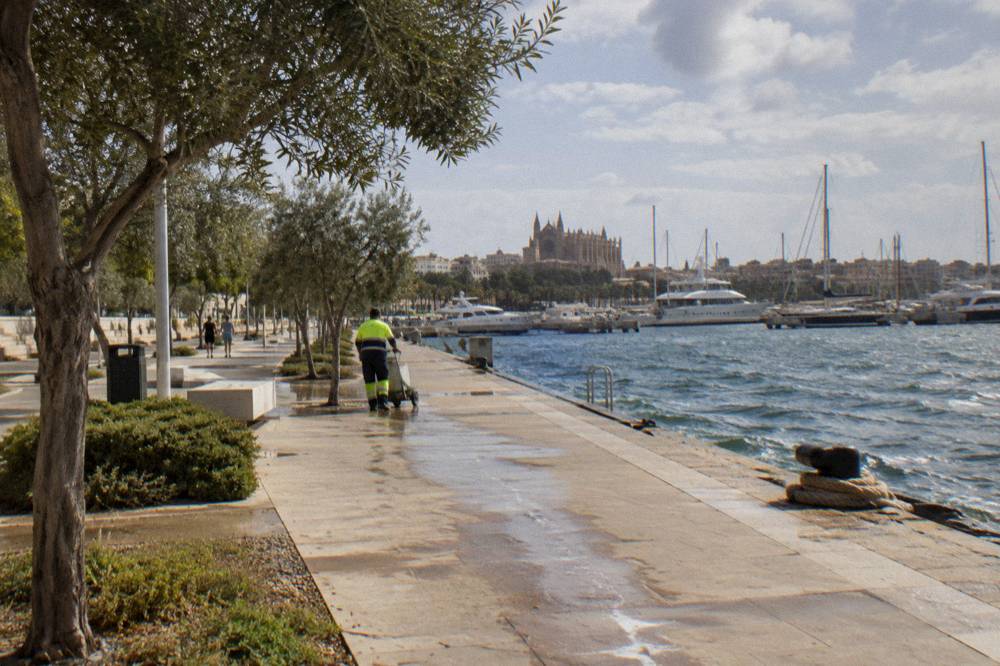
Palma's departure points have changed character recently. The Paseo Maritimo, the waterfront avenue where several of these piers sit, has been redeveloped over 3.5 km with fewer traffic lanes, more than 1,800 added trees and about 70 percent more pedestrian and green space, and the project has won a national sustainable construction prize, as reported by Mallorca's local press. Arriving at the Muelle de Golondrinas on foot or by taxi is now a noticeably pleasanter walk than it was a few years ago. Separately, it has been reported that party boats were excluded from the new Muelle de las Golondrinas concession; no claim is made here about which listings are affected.
| Departure Port | Listings Covered Here | Shared Price Basis | Example Listing |
|---|---|---|---|
| Palma and Arenal | 14 of 19 | From $44.82 to $125 per person; private charters from $1,389.36 per boat | Palma: Catamaran Cruise with Swimming and Snorkelling |
| Port d'Alcudia | 3 | From $45.55 to $85 per person (North Coast category) | Catamaran Cruise from Port d'Alcudia with Lunch and Swim Stop |
| Port de Pollenca | 1 | From $78 per person (North Coast category) | Mallorca Catamaran Tour in the Bay of Pollensa |
| Cala Ratjada | 1 | From $113 per person (East Coast category) | Day Catamaran Trip: Cap des Freus and Llevant Natural Park |
The east coast entry deserves its own line. The day catamaran trip to Cap des Freus and Llevant Natural Park, from $113 per person and rated 4.6 from 16 reviews, runs four hours from the pier at Cala Ratjada with stops at Capdepera, Cala Ratjada, Cala Agulla and Arta, a traditional Mallorcan barbecue lunch, and snorkel equipment. It is the one listing here that sails a natural park, which is the closest thing in this set to the framing a dolphin-trip buyer is looking for: protected water, wild coastline, animals in their habitat. It is still not sold as a dolphin trip, and a sighting remains a bonus rather than a promise.
What Might You See Instead Of Dolphins On A Catamaran Day?
The reliable sights on these trips are underwater rather than alongside: fish and the occasional seahorse are reported on east-coast glass-bottom trips, and Posidonia meadows are visible in snorkel contexts. On deck, the constants are coastline, cathedral and lighthouse views, swim stops and the seabed through several metres of clear water. Loggerhead turtles nested on a Palma city beach in 2025 and 34 hatchlings were released, but no listing here promises turtle sightings.
Snorkelling is where a Mallorca sea day delivers its most dependable wildlife. The listings that include snorkel gear name it plainly, and the marine reserve at Cala Vella, the stop for several Palma sailings, is the kind of protected water where fish are easy to find over the seagrass. The seahorse reports come from glass-bottom contexts on the east coast, which is a different product again; the glass-bottom catamaran options in Mallorca guide covers that corner of the market. What you see with a mask on is small, close and nearly certain, which is the exact opposite of a dolphin watch.
The turtle story is worth knowing for its own sake. Loggerheads nested on Can Pere Antoni, the city beach in Palma, in 2025, and 34 hatchlings were released. What that says about the state of the sea is a question for marine biologists, not tour copy, but it does help explain why the anchoring and mooring rules described above are taken seriously. It is not a reason to expect a turtle on any particular trip, and no honest listing would sell it that way.
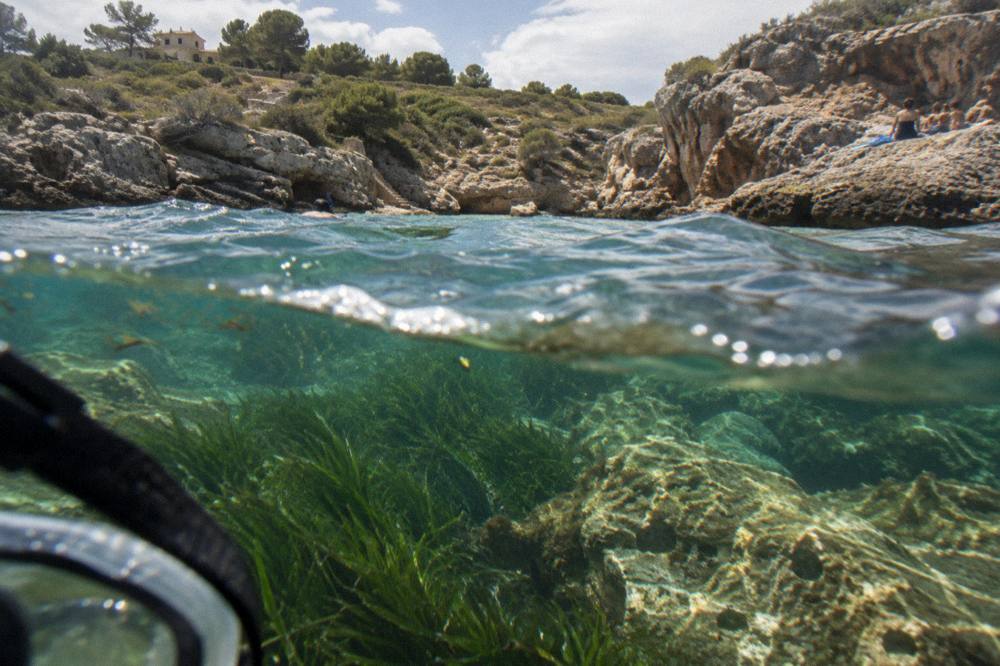
Sorting the island's marine sightings into what is dependable and what is a gift is the clearest way to set expectations before money changes hands. The table below does exactly that, using only what the reports and listings actually support.
| Marine Sighting | Where It Is Reported | How Dependable |
|---|---|---|
| Fish over Posidonia meadows | Snorkel stops such as the Cala Vella marine reserve | Very dependable with a mask |
| Bottlenose dolphins | Boat trips off Santa Ponsa and Paguera, south-west coast | Reported by passengers, never promised |
| Loggerhead turtles | Nested at Can Pere Antoni, Palma, in 2025; 34 hatchlings released | A conservation story, not a tour stop |
| Seahorses | East-coast glass-bottom trips | Occasional reports only |
Timing shapes the whole day more than luck does. Average sea temperature near Palma runs from 13.9 degrees in February to 26.0 in August, which is the difference between a bracing dip and a long float; the best time for a catamaran tour in Mallorca guide works through the months. Sunset in Palma swings from 5:26 pm in mid-December to 9:18 pm in mid-June, so a "sunset" departure means very different things in spring and high summer. For a broader read on which sea day suits which traveller, the best boat trip in Mallorca question is covered on the blog.
The private option closes the argument for some groups. Discover paradisiacal coves aboard an exclusive catamaran, a private charter from $1,400.56 per group for up to 12 guests, runs four hours with a deli-style lunch, water, snorkelling gear and paddleboards, plus stops at two coves. It gives a family or a group of friends the whole boat and the skipper's judgment about where the water is best that day. That judgment is the private format's quiet advantage: on a shared sail the route is fixed, while a private skipper can weight the day toward the calmest, clearest water on offer.
A last word on expectations. The visitors who write the best reviews of these trips are the ones who came for the day, not for a single animal: the buffet on the way out, the long stop in the cove, the sail home with the coastline turning gold. Mallorca's sea delivers that reliably.
Common Questions About Dolphin Watching In Mallorca
Can You See Dolphins On A Catamaran Tour In Mallorca?
Dolphins are reported by passengers on boat trips off the south-west of Mallorca, on the Santa Ponsa and Paguera routes, and none of the catamaran listings covered here departs from those ports. No listing on this site is a dolphin-watching trip. A sighting from a catamaran is possible as a bonus but is never part of what these tours sell.
Where Are Dolphins Most Often Reported In Mallorca?
The reports gathered here come from the south-west coast, specifically the Santa Ponsa and Paguera routes, described by passengers on dedicated dolphin-watching boats during 2026. No catamaran listing covered here sails those routes, and no frequency or season claim is verified beyond the reports themselves.
How Close Can A Boat Legally Get To Dolphins In Spain?
Real Decreto 1727/2007 creates a mobile protection space of 500 m radius around any cetacean or group. The exclusion zone runs to 60 m, a restricted-permanence zone runs from 60 m to 300 m, and an approach zone runs from 300 m to 500 m. Boats may not enter the exclusion zone, so every legal encounter in Spanish waters is a watched one at distance.
What Is The Best Tour If I Want To Be On The Water But Accept I May Not See Dolphins?
The Palma catamaran cruise with swimming and snorkelling fits that brief: from $44.82 per person, rated 4.3 from 3,255 reviews, and on the water for two to four hours. It calls at Cap Enderrocat and Cala Vella, with snorkel equipment aboard and a BBQ option. Those inclusions are fixed parts of the itinerary, not dependent on sightings the way a dolphin trip is.
Are There Whales Or Turtles Around Mallorca?
Loggerhead turtles nested on Can Pere Antoni beach in Palma in 2025 and 34 hatchlings were released, which points to recovering nearshore water. Fish and the occasional seahorse are reported on east-coast glass-bottom trips. None of the listings covered here promises a turtle, seahorse or cetacean sighting of any kind.
Does A Private Charter Improve The Odds Of Seeing Dolphins?
No format changes where dolphins are. The private catamarans covered here, from $1,389.36 per group for up to 12 guests, charter in the Bay of Palma, while the reported dolphin activity is off the south-west coast. A private skipper does give you flexibility on coves and timing, which is the real reason to consider the format.